

Felix Teiretzbacher founded the Kaffeelix roastery (formerly FELIX KAFFEE) in 2012 in St. Pölten, Austria. He made his debut as a home roaster at his then café Cimbalino in Krems - the desire for his own coffee became the seed of his entrepreneurial journey. From the beginning, Kaffeelix has focused on select coffees with a minimum rating of 80 points on the cupping scale.
The roastery works with a very gentle, light roast to bring out the natural aromas of each variety, not roasted notes or bitterness . The high quality is ensured by a combination of experience and technology: hand drum roasters (7.5 kg and 30 kg Coffeetool brand) from Greece, modern Giesen W1A and Cropster software for a reproducible and precise roasting process. The result is clean, fruity and playful profiles - an approach that earned Felix the title of Austrian Champion in 2019 and then defended his title at the World Coffee Roasting Championships in 2022.
Coffees from Kaffeelix
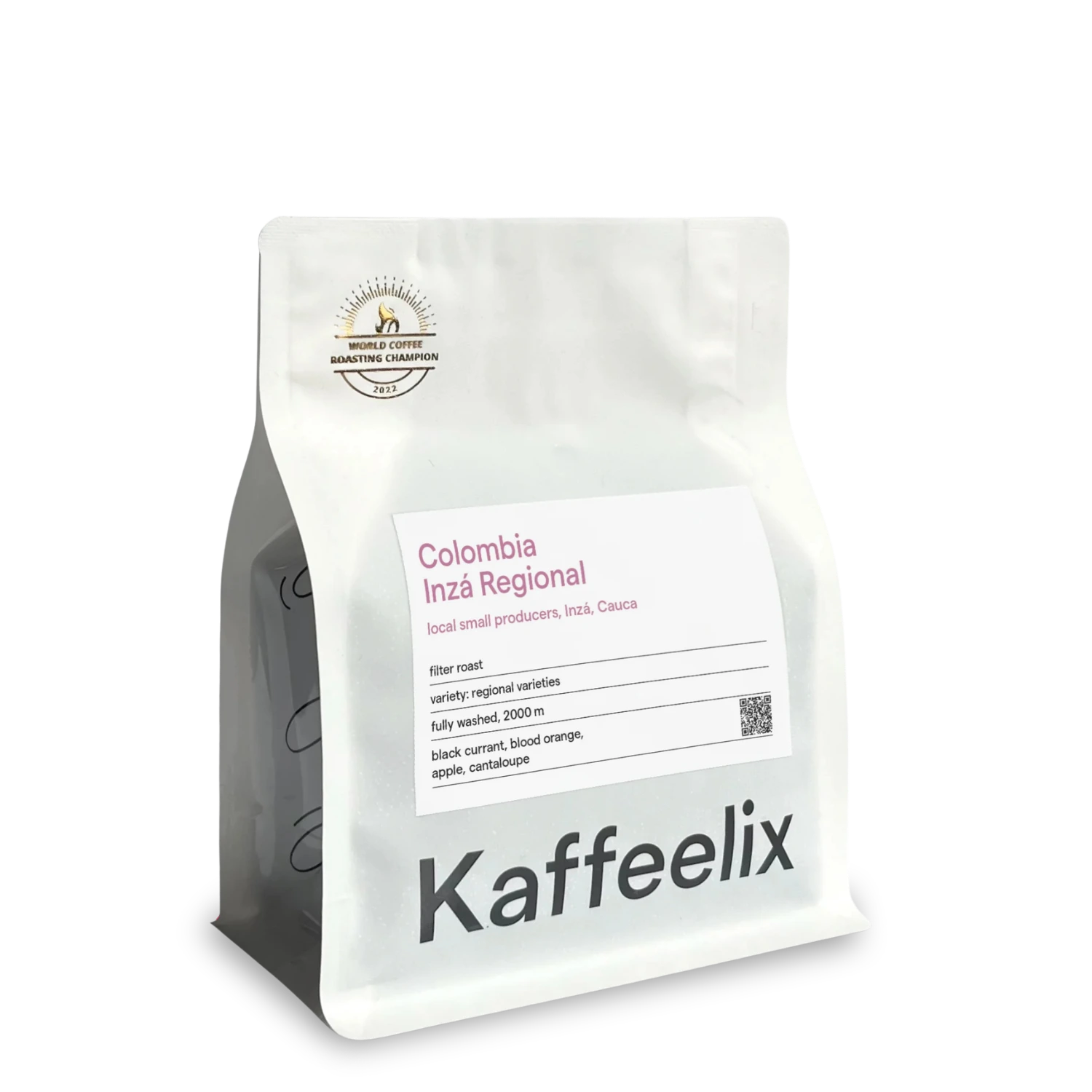
Black currant, blood orange, apple, cantaloupe
Colombia Inza Regional
KaffeelixHigh up on Colombia’s Macizo Colombiano plateau, 290 small-scale farmers—members of the Asorcafe association—grow coffee. The Austrian roastery Kaffeelix has used their harvest to create a filter coffee in which black currant and blood orange take center stage.
The town of Inzá in the department of Cauca lies on the high-altitude plateau of the Macizo Colombiano, where the elevation exceeds 2,000 meters. These are ideal conditions for specialty coffee. The place has a long history: in 1577, the Spaniard Sancho García de Espino set up camp here; in 1737, the Jesuits built a church, and a small town gradually grew up around it, which the Colombian government officially recognized as a municipality in 1907. Today, Inzá is known primarily for its indigenous history and coffee. Behind this lot stands the Asorcafe association, founded by local growers in 2003. It brings together 290 small-scale producers with plots ranging from 1.8 to 2 hectares. In addition to selling specialty coffee, it also focuses on educating its members and improving the living conditions of their families and the entire community. The farms are located at altitudes of up to 2,100 meters. They grow Caturra, Typica, Bourbon, Tabi, Castillo, and a small amount of Pink Bourbon, which is why the packaging simply lists “regional varieties.” Processing is traditional, fully washed. After harvest, the pulp is removed from the cherries, and the beans are then fermented for 20 to 40 hours, depending on local conditions. They are then washed, unripe beans are sorted out, and the beans are dried for 8 to 15 days in parabolic dryers. The coffee was brought to Europe by Siruma, a Colombian partner of the roastery. Samples are first evaluated during a cupping session, and moisture content and yield are also checked. Asorcafe was then paid immediately upon delivery to the warehouse in Manizales. It was roasted by Kaffeelix, a roastery in St. Pölten led by Felix Teiretzbacher, the 2022 World Coffee Roasting Champion. The coffee received a cupping score of 85.5 points. In the cup, expect pronounced notes of black currant and blood orange, complemented by apple and cantaloupe.
This coffee is only available in our monthly subscription. Join us and discover new flavors every month!
Choose Subscription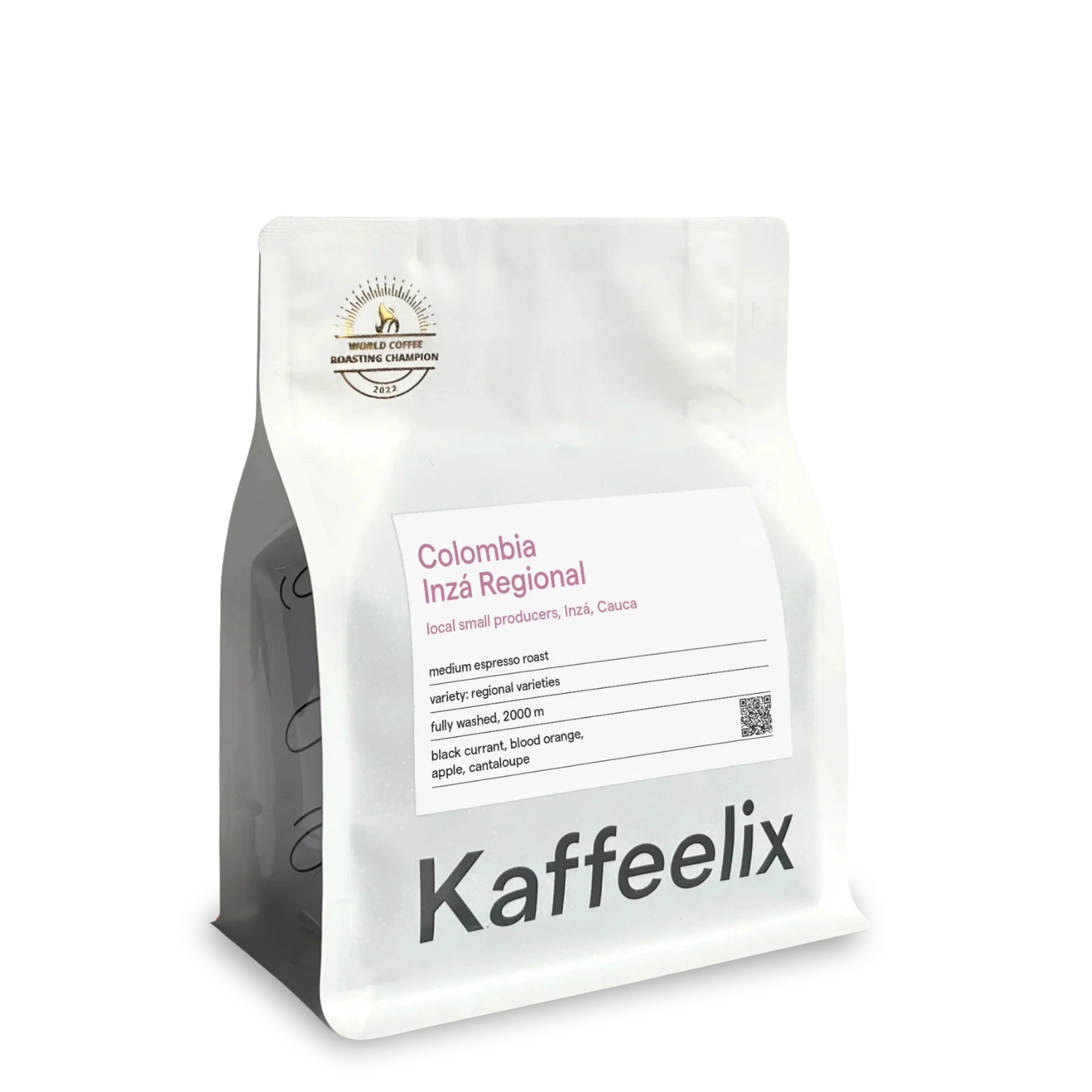
Black currant, blood orange, apple, cantaloupe
Colombia Inza Regional
KaffeelixTwo thousand meters above sea level, small family-run farms, and traditional processing. Austria’s Kaffeelix imports an espresso from Inza, Colombia, with a Cup Score of 85.5, featuring notes of black currant and blood orange.
The town of Inzá is located in the Cauca Department, high in the Colombian Massif (Macizo Colombiano), where coffee plantations reach altitudes of over two thousand meters. These are ideal conditions for specialty coffee. The region is known primarily for its indigenous history and coffee. The first settlement here was established in 1577 by the Spaniard Sancho García de Espino; a Jesuit church was added in 1737, and Inzá officially became a municipality in 1907. The coffee is supplied by the Asorcafe association, which was founded in July 2003 and today brings together 290 small-scale growers with plots of land averaging about two hectares. It helps them market their coffee as specialty coffee, as well as continue their education and improve the lives of their families and the entire community. The Colombian partner, Siruma, conducts cupping tests on the samples, monitors moisture content and yield, and pays the growers immediately upon delivery of the coffee to the warehouse in Manizales. A diverse mix of varieties grows on the farms: Caturra, Typica, Bourbon, Tabi, Castillo, and a small amount of Pink Bourbon. That is why the label simply states “regional varieties.” The coffee is traditionally washed. After harvest, the cherries are pulped and fermented for 20 to 40 hours, depending on local conditions. The beans are then washed, unripe beans are sorted out, and they are dried for 8 to 15 days in parabolic dryers. It was roasted by the Austrian roastery Kaffeelix in St. Pölten, led by Felix Teiretzbacher, the 2022 World Coffee Roasting Champion. He roasted the coffee specifically for espresso. In the cup, expect notes of black currant and blood orange, complemented by apple and the sweetness of cantaloupe.
This coffee is only available in our monthly subscription. Join us and discover new flavors every month!
Choose Subscription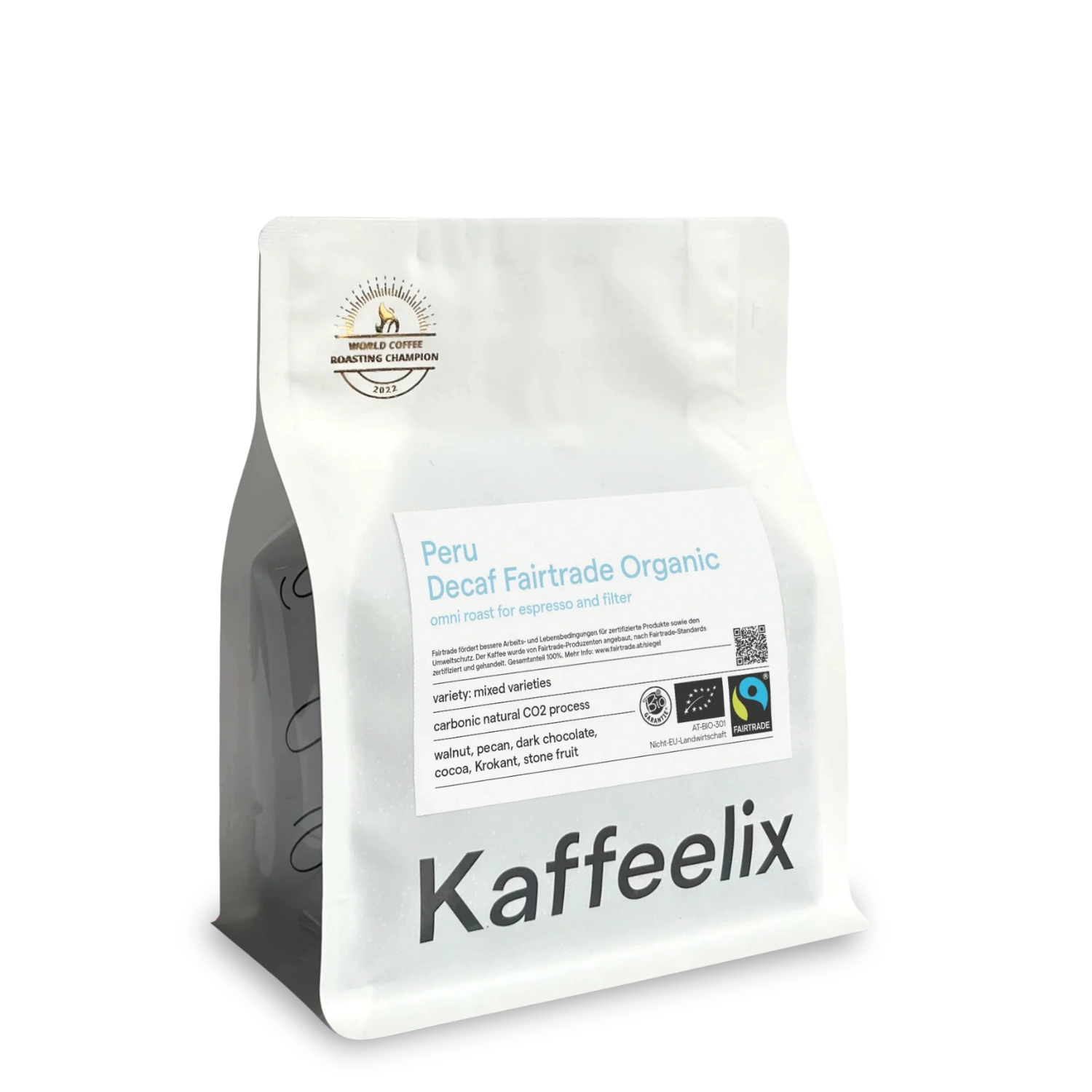
Walnuts, pecans, dark chocolate, cocoa, nougat, stone fruits
Decaf Organic Fair Trade
KaffeelixThe Austrian roastery Kaffeelix, led by 2022 World Roasting Champion Felix Teiretzbacher, turned to Peru for its decaf. The result is an organic, Fairtrade decaf coffee that delivers notes of nuts, dark chocolate, and brittle in the cup.
The base is a blend of varieties from Peru, which the roaster does not specify in detail. The caffeine has been removed using liquid carbon dioxide. The carbon dioxide circulates through the beans in giant tanks, dissolving the caffeine while leaving behind the other compounds responsible for the flavor. Kaffeelix makes no secret of this and links to a video on the product page featuring James Hoffmann, who visited the facility where this coffee was decaffeinated. In the cup, you’ll find a rich nutty profile: walnuts and pecans, dark chocolate, cocoa, and brittle, complemented by notes of stone fruit. The coffee is roasted as an “omni roast,” so it works well for both espresso and drip coffee. The roastery is located in St. Pölten, Lower Austria. Teiretzbacher founded it in 2012, then under the name Felix Kaffee, originally so he could roast coffee for his own café, Cimbalino, in Krems. In 2019, he won the first Austrian Roasting Championship. Kaffeelix favors a lighter roast that doesn’t overwhelm the coffee’s character with bitterness or roasted notes, and strives to source green coffee as directly as possible.
This coffee is only available in our monthly subscription. Join us and discover new flavors every month!
Choose Subscription
fine sour, nut, milk chocolate, carambola (star fruit)
Want to taste coffees from Kaffeelix?
With our subscription, you can taste coffees from various European roasters every month. Fresh specialty coffee delivered right to your door.
Learn more about subscription →