How many cups of coffee can you make from one bag? It sounds like a simple question, but there is no single answer: it depends on how you brew and how much coffee goes into each cup. A 250 g bag can give you fourteen double espressos, sixteen mugs of filter coffee or around thirty Turkish coffees. In this article you will find a clear dosing guide for every common brewing method, the numbers for 250 g and 1 kg of coffee, how much coffee you are likely to drink in a month, and what a cup of specialty coffee really costs you at home.
Quick answer: A 250 g bag of whole beans makes roughly 14–16 double espressos (at a dose of 16–18 g) or about 16 mugs of filter coffee (15 g per 250 ml of water). One kilo gives you about 55–62 double espressos or around 66 mugs of filter. In practice, expect to lose a few cups to dialing in your grinder.
How many grams of coffee per cup
Every calculation starts with the dose. It changes with the brewing method, because each method works with a different ratio of coffee to water. These are the typical doses baristas use:
- Espresso (single): 7–10 g of coffee for 25–30 ml in the cup.
- Espresso (double): 16–20 g of coffee for 35–45 ml in the cup. This is now the most common base for a cappuccino or a flat white.
- Filter coffee (V60, Chemex, Kalita): a ratio of 1:15 to 1:17, or about 15 g of coffee per 250 ml of water.
- French press: a ratio of 1:14 to 1:16, or about 30–35 g of coffee per half liter of water.
- AeroPress: 12–18 g of coffee, depending on the recipe and whether you dilute the brew afterwards.
- Moka pot: depends on the size. A small 3-cup pot takes about 15–17 g of coffee, a larger 6-cup pot around 30 g.
- Turkish coffee (cezve or ibrik): 7–10 g per cup.
- Bean-to-cup machine: usually 7–12 g per drink, depending on the strength setting.
If you measure with a spoon, a level coffee scoop holds roughly 7–8 g of ground coffee; with whole beans it varies with their size and density. That is why weighing pays off. More on precise dosing below.
How many cups of coffee in 250 g
The 250 g bag is the standard size in the coffee world. At typical doses it makes:
- Double espresso (16–18 g): 14–16 cups
- Single espresso (8–9 g): 28–31 cups
- Filter coffee (15 g per 250 ml): about 16 mugs
- French press (30 g per 0.5 l): about 8 pots, or roughly 16 mugs
- AeroPress (15 g): about 16 cups
- 3-cup moka pot (16 g): about 15 pots
- Bean-to-cup machine (9 g): about 27 drinks
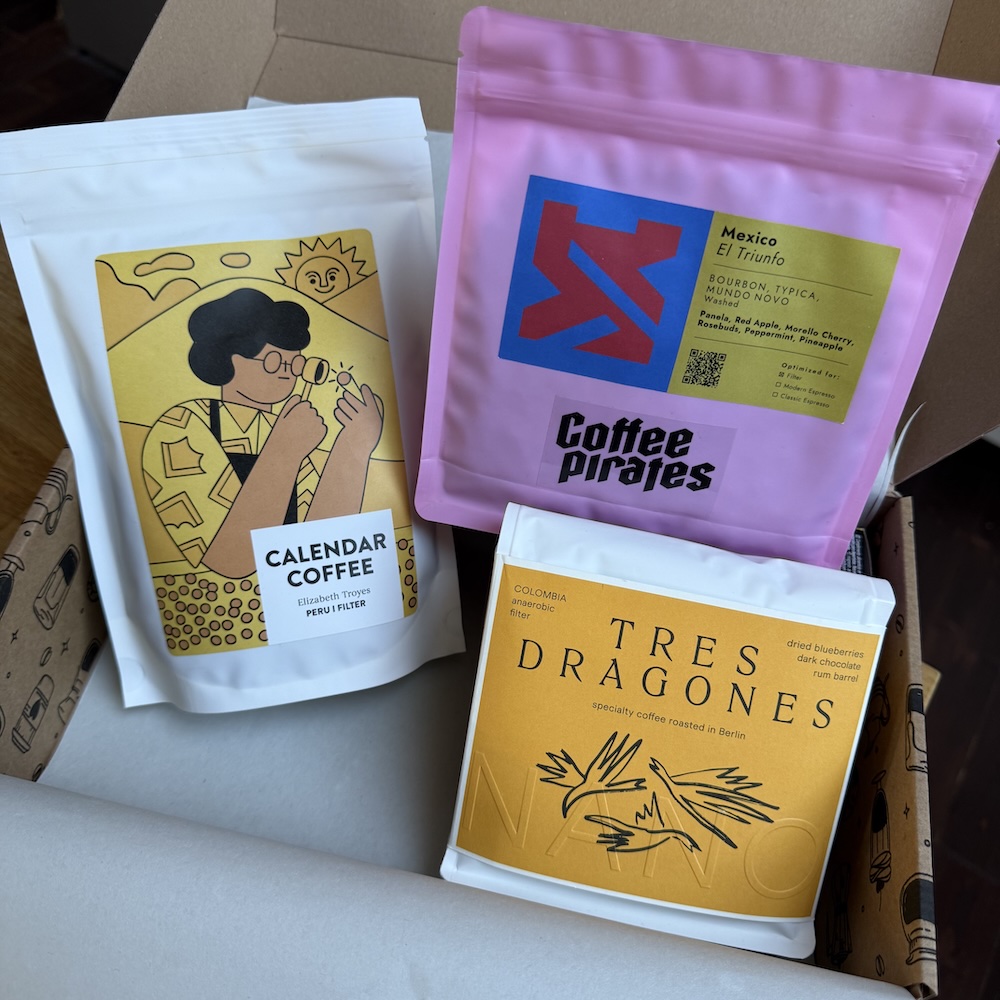
Coffees from European roasters in our shop
In the KAVI shop you will find specialty coffees for espresso and filter from roasters you rarely find in local shops. Based on the numbers above, one bag lasts about two weeks if you drink one double espresso a day.
How many cups of coffee in 1 kg
For a one-kilo bag the math is the same, just four times bigger:
- Double espresso (16–18 g): 55–62 cups
- Single espresso (8–9 g): 110–125 cups
- Filter coffee (15 g): about 66 mugs
- French press (30 g per 0.5 l): about 33 pots
- Bean-to-cup machine (9 g): about 110 drinks
So a kilo of coffee lasts one person who drinks a double espresso a day about two months. Keep freshness in mind, though: once opened, coffee gradually loses its aroma, so a one-kilo bag makes most sense in a household that drinks a lot of it. We explain how to keep coffee fresh for as long as possible in How to Store Coffee and Keep It Fresh.
How much coffee for a cappuccino, latte, americano or Turkish coffee
Milk drinks and other espresso variations don't require anything new. The base is always espresso, so the dose depends on whether you make a single or a double:
- Cappuccino: 8–9 g of coffee for a single espresso, although specialty coffee shops more often use 16–18 g for a double. The milk doesn't change the dose.
- Flat white: almost always a double espresso, so 16–20 g of coffee. That is why it tastes more of coffee than a cappuccino does.
- Caffè latte: a single or double espresso, depending on the size of the cup. For a large latte (300 ml or more), go with a double, or the coffee gets lost in the milk.
- Americano: espresso topped up with hot water, so the dose is the same as for espresso: 8–9 g, or 16–18 g for a larger cup.
- Turkish coffee: 7–10 g of very finely ground coffee per cup. That gives you about 25–35 cups from 250 g.
- Iced latte: the same dose as the hot version; you just pour the espresso over ice and top it up with cold milk.
If you drink coffee with milk every day, work out your consumption the same way as for espresso. Milk drinks use the same amount of coffee; they are just bigger. We cover which coffee works best with milk in Specialty Coffee with Milk.
Why you get a few cups less in practice
The numbers above are theoretical. In reality you will usually get one to three cups fewer per bag. The reasons are mundane:
- Dialing in the grinder. With every new coffee, especially for espresso, it takes a few attempts to find the right grind size.
- Coffee left in the grinder. Electric grinders retain anything from a few tenths of a gram to several grams of coffee.
- Spilled beans and grounds. A small loss, but it adds up over a month.
- Bigger doses. If you brew a large mug of filter coffee (350–400 ml), you use 22–25 g per cup.
How much coffee you drink in a month
Now for the most practical part: how much coffee to order so you never run out, but it doesn't sit around going stale either. We count a month as 30 days:
- 1 double espresso a day (17 g): about 510 g a month
- 1 large mug of filter coffee a day (15–18 g): 450–540 g a month
- 2 single espressos a day (2 × 8 g): about 480 g a month
- 2 double espressos a day (2 × 17 g): about 1 kg a month
- A two-person household, one coffee each a day: 900 g to 1 kg a month
Put these numbers next to the sizes of the KAVI coffee boxes and you get a simple rule of thumb:
- M box (500 g, 2 bags): for one person who has one larger coffee a day (a double espresso or a mug of filter), or two smaller ones.
- L box (750 g, 3 bags): for someone who sometimes has a second coffee, or for a couple where one drinks more and the other less.
- XL box (1,000 g, 4 bags): for a household of two coffee drinkers, or for one person who drinks two double espressos a day.
Drink less? Your box doesn't have to arrive every month. You can also set your subscription to every two or every three months; an L box every two months works out to about 375 g of coffee a month.
What a cup of specialty coffee costs at home
At first glance, specialty coffee looks expensive. A bag at roughly €12–20 costs more than supermarket coffee. But once you work out the price per cup, it looks very different.
The math is simple:
- Divide the price of the bag by the number of grams. That gives you the price per gram.
- Multiply the price per gram by the dose you put in each cup.
Example: The KAVI M box costs €35 for 500 g of specialty coffee. That is €0.07 per gram. At a 16 g dose one cup comes to about €1.10, at 18 g about €1.26. With the larger boxes each gram costs less, so a cup is even cheaper.
For comparison, a cup of specialty coffee in a coffee shop costs several times as much. At home you also pay for milk, water and energy, plus a one-off investment in equipment, but even so, specialty coffee at home is surprisingly affordable, especially when you consider that you are drinking coffee from roasters you would otherwise only get to try on trips to other European cities.
A cup costs less with a subscription
In a KAVI subscription, a box costs €5 less than the same box ordered as a one-off. The M box with 500 g of coffee costs €35, which works out to about €1.10 per cup.
How to dose coffee precisely
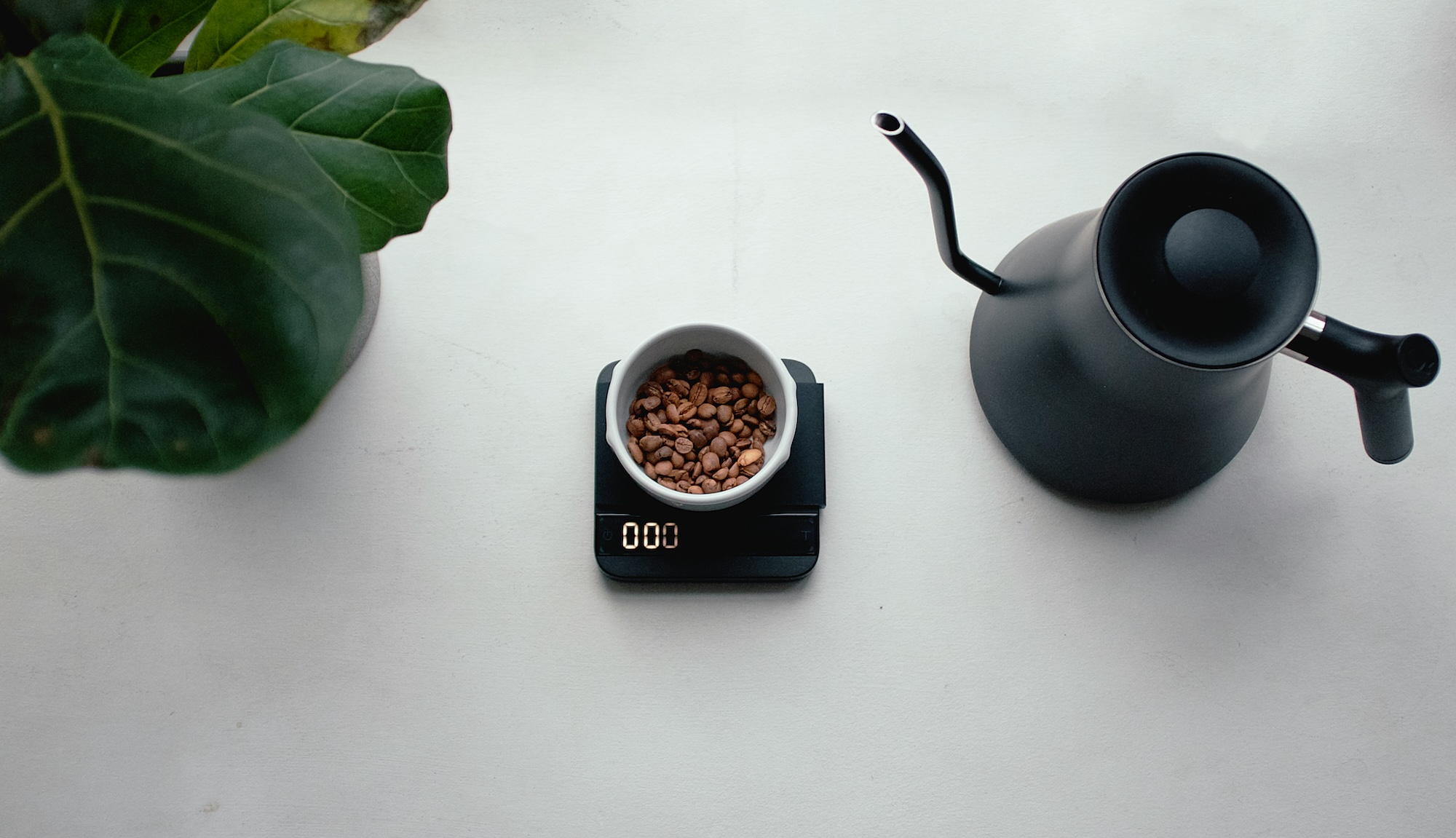
If you want your coffee to taste consistently good, weigh it. An ordinary kitchen scale accurate to one gram will do; even better is a coffee scale accurate to 0.1 g with a built-in timer. Here is how:
- Pick a ratio. For filter, start at 1:16 (15 g of coffee to 240 ml of water); for espresso, start at 1:2 (18 g of coffee, 36 g in the cup).
- Weigh the coffee before grinding and grind it just before brewing.
- Weigh the water as you pour: 1 ml of water is 1 g.
- Then fine-tune the ratio to taste. If the coffee is weak and watery, add more coffee. If it is too intense, use less.
You will find guides to individual brewing methods in How to Make Coffee at Home: 4 Methods and How to Make Espresso at Home.
Frequently asked questions
How much coffee should I use for one cup of filter coffee?
About 15 g of coffee per 250 ml of water, which is a ratio of roughly 1:16. If you like it stronger, go for 1:15; for a lighter cup, 1:17.
How many espressos are in 1 kg of coffee?
About 55–62 double espressos (16–18 g) or 110–125 singles (8–9 g).
How much coffee goes into a French press?
For a half-liter French press, use 30–35 g of coarsely ground coffee. Let it steep for 4 minutes, then press the plunger down slowly.
How long does 250 g of coffee last?
About two weeks at one double dose a day. Once a bag is open, though, it is best finished within two to four weeks, so it is better to order smaller amounts more often than to stock up.
Why do I get fewer cups from a bag than I should?
Because of dialing in the grinder, coffee left inside the grinder and small losses while brewing. Allow a margin of one to three cups per bag.
Know how much coffee you drink? Set up a KAVI coffee subscription to match exactly what you drink: an M, L or XL box, delivered every month, every two months or every three months. Your box goes to a Packeta pickup point or parcel locker of your choice, and you can change the box size any time.