A coffee subscription is the most convenient way to always have fresh coffee at home without having to think about it. But there's a lot to choose from: dozens of roasters, coffee shops and even coffee machine brands now offer subscriptions – and the individual services differ more than they seem at first glance. In this guide, we explain how a coffee subscription works, which types you'll come across, the nine criteria to choose by, and how to work out whether a subscription is worth it for you.
Quick answer: A good coffee subscription sends whole-bean coffee with a roast date on the bag, lets you choose between coffee for espresso and for filter, and lets you pause or cancel at any time. If you love the style of one particular roaster, go for their subscription. If you want to explore, choose a subscription that selects coffees from several roasters.
How a coffee subscription works
The idea is simple. You set once how much coffee you want, how you brew it and how often it should arrive, and the roaster or curator then sends it to you regularly. Payment is usually charged automatically to your card, or you pay upfront for the whole period.
A typical subscription has four settings:
- Amount – most often one to four 250 g bags.
- Coffee type – for espresso (and bean-to-cup machines), for filter, or a mix.
- Frequency – once a month, once every two months, and with some services more often.
- Delivery method – to your home address, to a parcel locker, or to a pickup point.
Unlike regular online shopping, you don't choose specific coffees. That's both the biggest advantage and the only “risk” of a subscription: you leave the choice to experts and get coffees you might never have found on your own.
Who a coffee subscription suits (and who it doesn't)
A subscription makes the most sense if:
- you drink coffee regularly and don't want to keep track of when you'll run out,
- you want freshly roasted coffee at home at all times,
- you enjoy discovering new flavors, countries and roasters,
- you're looking for a gift that brings joy again and again.
On the other hand, it may not suit someone who always drinks one particular coffee and doesn't want to change anything – that kind of coffee drinker will save more hassle by regularly buying their favorite coffee straight from the roaster. Nor does it suit someone who drinks coffee only occasionally: the coffee would just go stale at home.
Types of coffee subscription you'll come across
Type “coffee subscription” into a search engine and you'll see dozens of offers. Most of them, though, fall into four groups that differ in what matters most: where the coffee comes from and who chooses it.
1. A single-roaster subscription
The most common type. Most specialty roasteries offer their own subscription. You get coffees from one roaster's range, often based on the current season.
Pros: a consistent roasting style you know, a short journey from the roaster to you, and support for a specific local business. Cons: all the coffees carry one roaster's signature, and over time the flavors may start to repeat.
Who it's for: anyone who has already found their favorite roaster.
2. A subscription from several roasters' ranges
Some specialty coffee shops offer a subscription that combines coffees from several roasters, most often local ones. You get a greater variety of styles, but still mostly within your local scene.
Who it's for: people who want to get to know different local roasters without ordering from each one separately.
3. A curated subscription of roasters from abroad
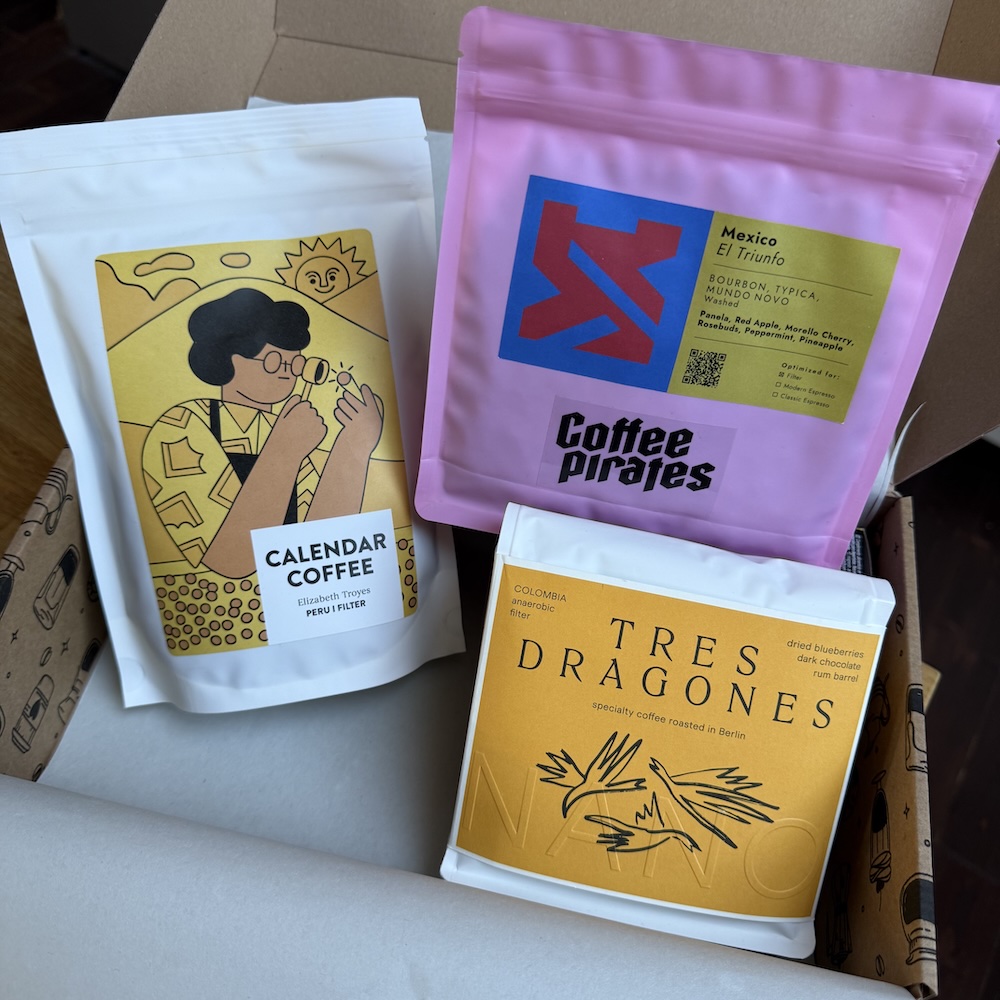
This type selects coffees from roasters you rarely find in local shops. A typical example is the KAVI coffee subscription: every month it sends coffees from three European micro-roasters – from Berlin, Rotterdam, Barcelona, Vienna and other cities. The range includes more than 40 roasters from nearly twenty countries, and they rotate through the boxes, so you come back to the same roaster roughly once a year.
Pros: the widest variety of flavors and roasting styles, and the chance to compare different approaches side by side. Cons: the coffee travels from the roaster to you, so it's weeks rather than days from the roaster – which, for specialty coffee, is actually more of an advantage, because it arrives rested and ready to brew.
Who it's for: curious coffee drinkers who want to explore, and those who already know their local scene.
4. Subscriptions from coffee machine and supermarket brands
Big coffee machine and coffee brands offer subscriptions too – often for capsules or their own blends, sometimes with a discount on coffee or a machine in exchange for a longer commitment. It's convenient and the price can be attractive, but it's usually not specialty coffee with traceable origin and a roast date.
Who it's for: people who care mainly about convenience and price, not about discovering flavors.
What's in the KAVI box this month?
On the Coffee of the Month page, we show which three European roasters and which countries the coffees in the current box come from. The selection changes every month.
9 criteria for choosing a coffee subscription
1. Freshness and roast date
The basic test for any subscription: is there a roast date on the bag? Specialty coffee tastes best from roughly a few days to a few weeks after roasting. But watch out for the opposite extreme – coffee roasted yesterday isn't ideal yet; it first needs to rest and release carbon dioxide. More in How Long to Rest Coffee After Roasting.
2. Whole beans, not ground
A good subscription sends whole beans. Ground coffee loses its aroma within hours, and after a month only a shadow of it would be left. If you don't have a grinder, it's the best investment you can make in the taste of your coffee – we explain why in Whole Bean vs Ground Coffee.
3. Coffee for espresso or for filter
Espresso coffees are usually roasted a little longer and have a fuller body; filter coffees are lighter and let fruitiness shine. A good subscription lets you choose, or offers a mix of both. If you have a bean-to-cup machine, choose espresso. We go into the differences in detail in Espresso Roast vs Filter Roast.
4. Bag size and delivery frequency
Work out how much coffee you actually drink. One double espresso a day means roughly half a kilo of coffee a month. The ideal subscription offers different sizes and frequencies, so you don't have to stockpile coffee at home or, on the other hand, run short. You'll find the exact calculation in How Many Cups of Coffee Are in 250 g and 1 kg.
5. Flexibility: pausing, changing and cancelling
This is where services differ the most. Some subscriptions are bought for a fixed period (say 3, 6 or 12 months) and paid upfront; others run month to month and can be paused or cancelled at any time. Before you order, check:
- whether there's a minimum subscription period,
- whether you can pause the subscription, for example while you're on holiday,
- whether you can change the box size or coffee type,
- how you cancel – ideally with one click in your account, with no fee.
6. Price per cup, not per bag
Prices are hard to compare because each service sends a different amount. So convert the price to price per gram, or straight to price per cup, and don't forget to add shipping if it isn't included. At 16 g per cup, specialty coffee brewed at home typically comes to around €1–2 per cup – much less than in a café.
7. Shipping and delivery
Is shipping included in the price? Do they deliver to your home address, to a parcel locker or to a pickup point? And when in the month do shipments go out? A fixed shipping date is an advantage – you know when your coffee will arrive and can plan around it.
8. Transparency of origin
With specialty coffee, you should know more than just the country of origin: the region, the farm or washing station, the variety, the processing method and ideally the producer's name. If a subscription sends only “an arabica blend”, it isn't specialty coffee in the true sense. We explain how to read this information in How to Choose Coffee Beans.
9. Variety and selection style
Ask yourself what you expect from a subscription. The reassurance of familiar flavors, or surprises? Coffees from one roaster, or variety from all over Europe? There's no better or worse answer – only the subscription that suits you.
How much does a coffee subscription cost, and is it worth it?
A monthly specialty coffee subscription usually costs somewhere between roughly €20 and €60, depending on how much coffee you get. To compare services fairly, use a simple calculation:
- Divide the price of one delivery by the number of grams of coffee (including shipping, if it's charged separately).
- Multiply the result by the dose you use per cup – usually 15 to 18 g.
Example: the M box from KAVI costs €35 for 500 g of coffee, which is €0.07 per gram. At a 16 g dose, a cup comes to about €1.10 (€1.26 at 18 g). With larger boxes, the price per gram is even lower. For comparison, a cup of specialty coffee in a café costs several times as much.
Whether a subscription works out cheaper than buying individual bags depends on the service. With some roasters the subscription is cheaper than a one-off purchase; with others you pay the same and “gain” mainly convenience. At KAVI, a box in the subscription is €5 cheaper than the same box ordered as a one-time purchase.
Work out your box
In the configurator, you choose the box size, coffee type and frequency and see the price straight away. You can then pause, change or cancel at any time in your account.
How to spot a good subscription: a quick checklist
- The bag shows a roast date, not just a best-before date.
- It sends whole-bean coffee.
- You can choose espresso, filter or a mix.
- It gives the origin down to the region or farm, the variety and the processing.
- You can pause and cancel without a fee.
- It clearly states the price including shipping.
- It has a regular shipping date.
- It offers a gift option, if you want to give the subscription as a present.
How the KAVI subscription works
So you have something to compare against, here's a short overview of how our subscription works:
- Three European roasters every month. We choose the coffees so the box offers a range of flavors from different corners of the world.
- Three sizes: M (500 g, 2 bags), L (750 g, 3 bags) and XL (1,000 g, 4 bags).
- Coffee type: espresso, filter or a mix. You can also add one decaf coffee to your box.
- Frequency: every month, every two months or every three months. You can also order a box as a one-time purchase.
- Delivery via Packeta to pickup points and parcel lockers across Europe.
- Orders close on the 15th of each month, and boxes usually ship around the 20th.
- No commitment: you can pause, change the box size or cancel with one click in your account.
- A postcard with every coffee describing its profile and the roaster's story.
You'll find the details on the How It Works page, and an overview of all the roasters we work with on the Our Roasters page.
Frequently asked questions about coffee subscriptions
Can I cancel a coffee subscription at any time?
It depends on the service. Some subscriptions are paid upfront for a fixed period; others run month to month and can be cancelled at any time. With KAVI, you can cancel, pause or change your subscription at any time in your customer account, with no fee.
Is a subscription more expensive than buying coffee online?
Usually not. A subscription tends to cost the same as or less than a one-off purchase. Always compare the price per gram including shipping.
What if I don't like the coffee from my subscription?
Taste is individual, and that's part of discovering too. If, say, fruitier filter coffees don't suit you, try switching to espresso, or the other way round. With KAVI, you can change the coffee type in your account, and we're always glad to hear your feedback, which helps us fine-tune the selection.
Is a subscription suitable for a bean-to-cup machine?
Yes, just choose coffee for espresso. Bean-to-cup machines cope best with medium to darker roasts that have a fuller body.
Can I give a coffee subscription as a gift?
Yes, and it's one of the most popular coffee gifts. A KAVI gift subscription is available for 3 or 6 months, is paid once upfront and doesn't renew. You'll find more ideas in Gifts for Coffee Lovers.
Why can't I choose specific coffees?
Because the point of a subscription is discovery. A curator tastes dozens of coffees and picks the ones that make sense together. If you'd rather choose for yourself, you'll find specific coffees in the shop.
Want to discover coffees you rarely find in local shops? Try the KAVI coffee subscription: specialty coffee from three European roasters every month, delivered to a Packeta pickup point of your choice, with pause or cancel at any time.